← All universities

Massachusetts Institute of Technology

Cambridge, United States · Urban

AAUPrivateResearch
Acceptance
4.6%
QS World
#1
Tuition/yr
$66,720
Students
11,900
Founded
1861

MIT is not simply a university — it is the world's preeminent institution for science, engineering, and technology, and the single top-ranked institution in the QS World Rankings. Situated on the Charles River in Cambridge, Massachusetts, MIT draws students who want to build things that did not exist before: algorithms, molecules, machines, companies, and policies.

Campus

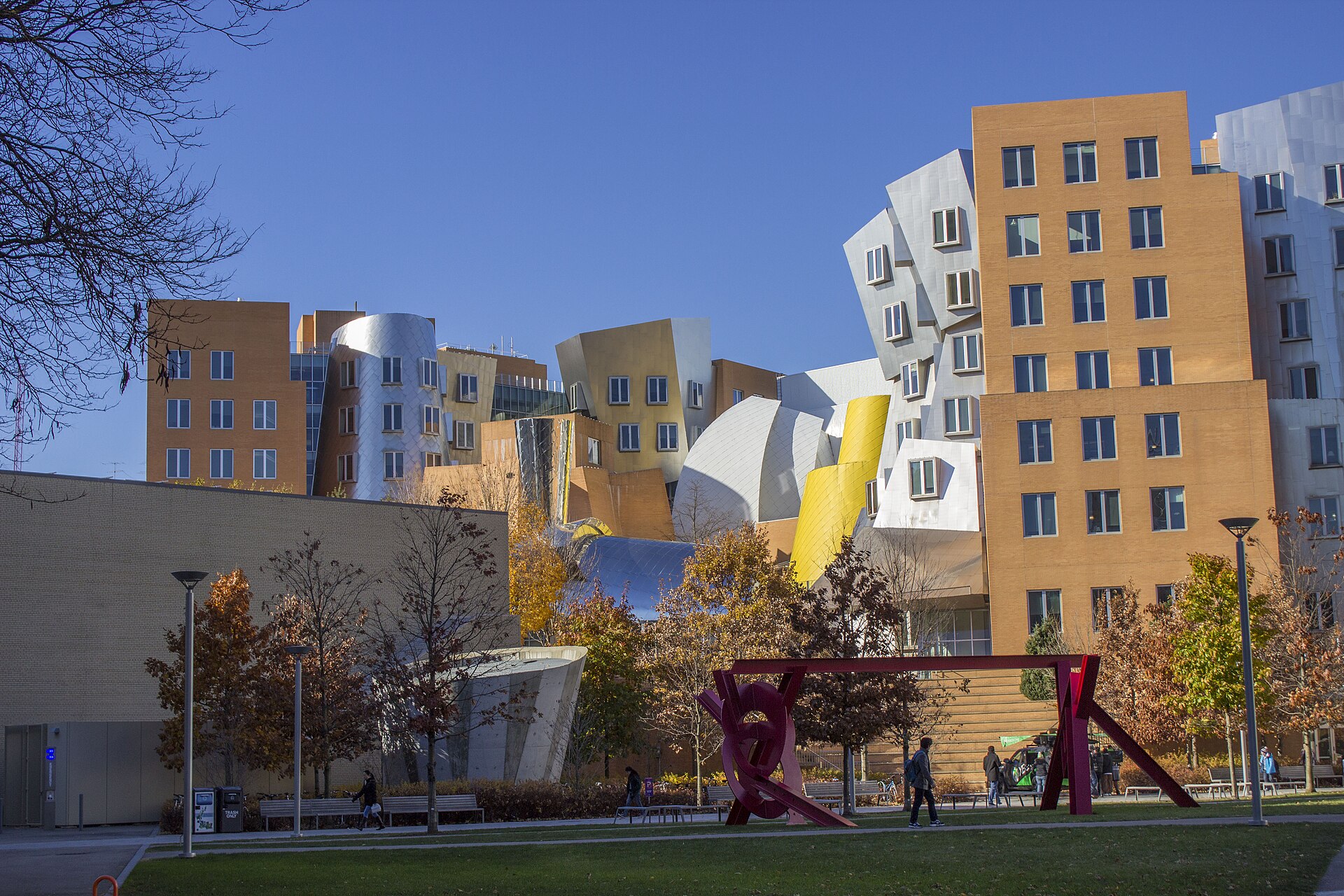
Massachusetts Institute of Technology — campus in pictures

Real, freely-licensed photographs of the campus (via Wikimedia Commons).
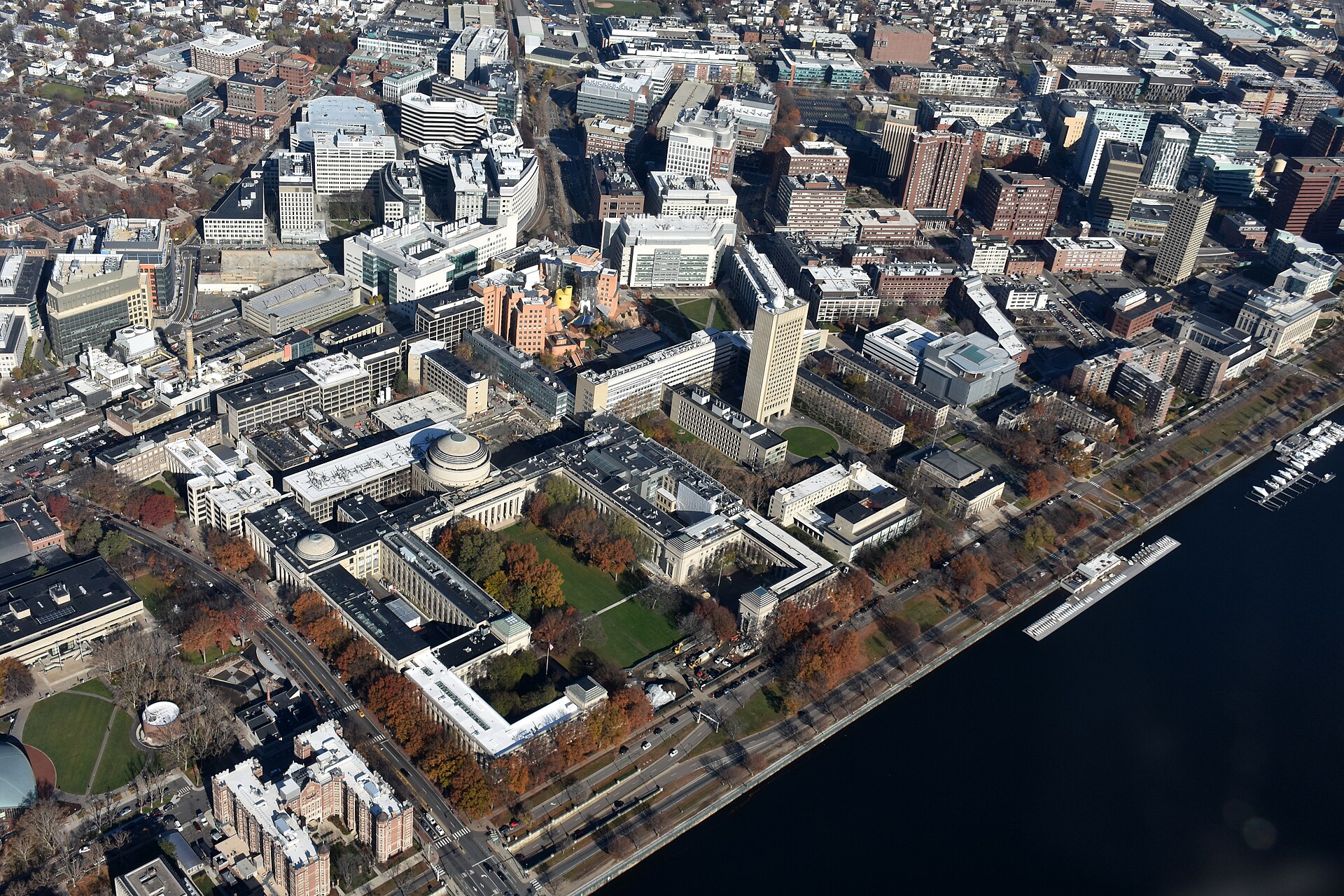
Aerial view of the East Campus of the Massachusetts Institute of Technology (MIT) along the Charles River
Aerial view of the East Campus of the Massachusetts Institute of Technology (MIT) along the Charles RiverNick Allen · CC BY-SA 4.0 · via Wikimedia Commons
Massachusetts Institute of Technology campus aerial all buildings 1921 US Army cropped
Massachusetts Institute of Technology campus aerial all buildings 1921 US Army croppedCaptain A. W. Stevens, US Army Air Service · Public domain · via Wikimedia Commons
MIT dynamo room Boston campus c1895 cropped
MIT dynamo room Boston campus c1895 croppedUnknown authorUnknown author · Public domain · via Wikimedia Commons
MIT Rogers Building 1872
MIT Rogers Building 1872Unknown authorUnknown author · Public domain · via Wikimedia Commons
MIT campus
MIT campusLucy Li · CC BY-SA 3.0 · via Wikimedia Commons
Aerial view of the Massachusetts Institute of Technology (MIT), facing north.
Aerial view of the Massachusetts Institute of Technology (MIT), facing north.Captain A.W. Stevens, U.S. Army Air Service · Public domain · via Wikimedia Commons

Why MIT — Research, Innovation & Global Impact

MIT is where the builders, solvers, and makers of the world train. For an international student committed to science, engineering, mathematics, or technology — and who needs to work on real problems with real consequences — MIT is without peer. A 3:1 student-to-faculty ratio, the Kendall Square innovation ecosystem, and an academic culture that rewards curiosity over credentials make it the defining institution of our era.

01World's #1 Ranked University
#1 in QS World University Rankings. MIT holds the top position globally in engineering, computer science, and physical sciences — the highest independent validation of research and academic quality on earth.
02UROP: Research from Day One
MIT's Undergraduate Research Opportunities Program (UROP) places students directly in faculty labs — often starting freshman year. This is not optional enrichment; it defines the MIT experience and distinguishes its graduates globally.
03Alumni Who Build the World
MIT alumni have founded companies whose combined value would make the MIT ecosystem the world's third-largest economy. The network is not a cliché — it is a documented, lifelong advantage in every STEM-adjacent field.
04Need-Blind for Every Student on Earth
MIT is one of only a handful of universities worldwide that is need-blind in admissions for ALL students — including international applicants — and meets 100% of demonstrated financial need. Ability to pay is never a factor.

MIT Acceptance Rate & Admitted Student Profile

Stats

4.6%
Acceptance Rate
30%
International Students
3:1
Student:Faculty Ratio

Profile Stats

1520–1580
SAT Middle 50%
34–36
ACT Middle 50%
43+
IB Typical Band
~30%
International Students
3.9
Min GPA (Unweighted)
~57%
Receive Financial Aid
Admitted Student Profile — Key Statistics
Overall acceptance rate (most recent cycle)

Rea Vs Rd

Rd Label: Regular Action
Rd Value: ~3%
Rea Label: Early Action (Non-Restrictive)
Rea Value: ~5–6%

MIT Admissions Requirements — Academics, Test Scores & Profile

GPA & Coursework
Value: 3.9+ Unweighted
  • Top 1–2% of graduating class expected
  • Rigorous course selection matters as much as GPA
  • HL Math AA (IB) or Further Maths (A-Level) essential for STEM
  • Teacher recommendations validate intellectual depth
Near-perfect grades in the most challenging courses available — IB Higher Level, A-Level, AP, or national equivalents. MIT evaluates your transcript school-by-school and in context of what was available to you.
SAT / ACT (Required)
Value: 1520–1580 SAT / 34–36 ACT
  • MIT REQUIRES test scores — not test-optional
  • SAT is superscored across sittings
  • ACT: single highest composite sitting
  • SAT Math 780–800 is a meaningful signal for STEM
Unlike most elite US universities, MIT requires standardised test scores for all applicants. Middle 50%: SAT 1520–1580; ACT 34–36. The Math section is scrutinised closely for STEM applicants.
International Grades
Value: Top 1–2%
  • IB: 43–45 points, 7s in relevant HL subjects
  • A-Levels: A*A*A or A*A*A* in STEM subjects
  • CBSE/ISC: 98%+ in core subjects
  • National Olympiad results (INMO, INPHO, IOI) are highly valued
For international students: IB 43–45 (7s in HL); A-Level A*A*A in STEM; Indian CBSE 98%+ in relevant subjects. Olympiad participation and research experience are the most powerful differentiators for international STEM applicants.

MIT Application Components — MyMIT Portal, Essays & Interviews

MIT does not use the Common Application — it has its own portal (MyMIT). Every component is evaluated holistically, with multiple admissions officers and faculty reading each file. There is no single threshold — MIT reads you as a whole person.

01RequiredMIT Application (MyMIT)
MIT does NOT accept the Common App. All applications go through MIT's own portal at apply.mitadmissions.org. Create your account early — the portal opens in late summer.
02RequiredFour Main Essays (100–200 words each)
MIT asks four short essay questions, each approximately 100–200 words. These are precision documents — not long-form personal statements. Every word must carry weight.
03RequiredFour Short Answer Questions (40–50 words)
Four ultra-brief short answers covering: what you do for fun, who you admire, a topic you could discuss for hours, and whether you are a generalist or specialist. Authentic voice over polish.
04RequiredSchool Transcripts & Secondary School Report
Official transcripts from all secondary schools attended. Your counselor submits the Secondary School Report providing context on your school's curriculum — critical for MIT readers evaluating international transcripts.
05RequiredTwo Teacher Evaluations
Two teacher recommendations from core academic subjects. MIT's forms are specific to its own system — not the Common App forms. Choose teachers who can speak to your intellectual curiosity and problem-solving.
06RequiredSAT or ACT Scores
MIT requires standardised test scores for all applicants — it is NOT test-optional. Submit either SAT or ACT. MIT superscores the SAT. The ACT uses your single highest composite sitting.
07Strongly EncouragedAlumni Interview
MIT arranges alumni interviews for most applicants worldwide. The conversation is informal — focused on what you have built, what fascinates you, and how you think. It supplements your written application.

MIT Essays — Four Prompts, 200 Words Each, Everything on the Line

Tips

Specificity wins at MIT
MIT admissions officers describe the hallmark of a strong essay as 'the click' — the specific detail that makes you real on the page. A named algorithm, a precise moment, a specific open problem you obsess over. Generic enthusiasm fails at MIT.
200 words is harder than 650
MIT's 100–200 word essays require a fundamentally different writing discipline. Draft at 400 words, then cut by half. What remains after ruthless editing is your actual answer. Every vague word wastes irreplaceable space.
The short answers are not mini-essays
The 40–50 word short answers reveal authentic personality in raw form. Do not over-edit them. MIT reads thousands of polished short answers that say nothing. An honest, specific, even surprising response is remembered.
Essays handle character, not achievements
MIT's activities section handles what you have done. Your essays handle who you are. Do not repeat activities content in your essays. Use the essays to reveal reasoning, failures, intellectual journey, and intellectual range.

Prompts

Essay 1 — Field of Study (100–200 words)
What field of study appeals to you the most right now? Reflect on what has led to this interest.
Essay 2 — Unconventional Path (100–200 words)
While some reach their goals following well-trodden paths, others blaze their own trails achieving the unexpected. In what ways have you done something different than what was expected in your educational journey?
Essay 3 — Problem-Solving Vision (100–200 words)
Reflect on how your personal and academic experiences have influenced the types of problems you would want to tackle with an MIT education, and who you would like to work on those problems with.
Essay 4 — Handling Challenges (100–200 words)
How did you manage a situation or challenge that you didn't expect? What did you learn from it?
The most common MIT essay mistake. Writing 650-word Common App prose compressed into 200 words — and hoping the length cut is enough. It isn't. MIT essays require a completely different structure, pacing, and level of specificity.

What MIT Admissions Officers Are Looking For

MIT admissions uses a holistic evaluation process. Every file is read by multiple reviewers. Understanding what each reviewer is looking for — and why — is the foundation of a strong application strategy. MIT is not looking for the highest GPA; it is looking for the most driven, curious, and capable builders.

01Genuine STEM Passion
MIT selects students who have demonstrated self-directed passion for science, engineering, computing, or mathematics — not because it is required for admissions, but because they cannot imagine doing anything else. What rabbit holes have you fallen into without being asked?
02Evidence of Initiative
Did you start something? Build something? Investigate beyond what was assigned? MIT values initiative enormously — whether that is a robotics team, a research project, a software tool you shipped, or a mathematics competition you drove yourself to master.
03Intellectual Curiosity
MIT expects you to pursue ideas for the joy of understanding them. The student who reads academic papers, programs for fun, or dives into number theory at midnight because they found a fascinating conjecture — this is the MIT student.
04Collaboration & Community
MIT is intensely collaborative. Its motto is mens et manus — mind and hand. Admissions looks for students who build things with others, not just alone. Your community contributions and how you have made teams better matter.
05Resilience & Grit
MIT is hard. Everyone who gets in knows it. MIT specifically looks for students who have faced challenges, adapted, and kept going — not students who have had every advantage and never struggled. How you handle failure reveals as much as how you succeed.
06Contextual Achievement
MIT reads every application in context. A student with limited resources who self-taught advanced mathematics is as compelling as one from an elite school with every advantage. MIT evaluates achievements relative to actual opportunities.

MIT Financial Aid & Scholarships for International Students

MIT's financial aid programme is among the most generous in the world — and uniquely, it applies equally to every student regardless of nationality. MIT is need-blind in admissions for all applicants worldwide and meets 100% of demonstrated financial need for every admitted student.

Aid amounts are estimates based on MIT's published guidelines. Individual packages are determined by MIT Student Financial Services on a case-by-case basis using the CSS Profile.

Stats

~57%
of MIT undergraduates receive a scholarship
~$69K
median annual MIT Scholarship award
$0
expected from families earning under $90K/yr
100%
of demonstrated financial need met

Contribution Tiers

NoteRangePercentPercent Value
Full cost typically covered — $0 family contributionUnder $90,000100%100
Very low contribution — typically under 10% of income$90K–$140K88%88
Moderate contribution — scaled to income$140K–$200K72%72
Significant contribution — grants still available$200K–$250K45%45
Need assessed case-by-case; aid may still applyOver $250K20%20
No-Loan Philosophy — What This Means. MIT's financial aid packages aim to exclude loans for students who receive institutional aid. The MIT Scholarship is a grant — money you do not repay. For qualifying families, MIT can genuinely cost less than a state university or a typical university in the student's home country.
Expected Contribution by Family Income (Approximate)

Key Dates

Early Action Deadline
Date: 1 Nov
EA Decision Released
Date: Mid-Dec
Regular Action Deadline
Date: Early Jan
RA Decisions Released
Date: Mid-Mar

Advantages

  • Slightly higher acceptance rate in EA vs Regular Action
  • Earlier decision — mid-December notification
  • NON-RESTRICTIVE: you may apply EA/ED elsewhere simultaneously
  • Signals genuine first-choice commitment to MIT
  • More time for financial aid comparison if deferred to RA

Disadvantages

  • Application must be complete by November 1
  • Less time to strengthen senior-year grades or achievements
  • If denied in EA, you cannot reapply in Regular Action
  • EA financial aid deadline is November 30 — tight turnaround
  • MIT's non-restrictive EA means less 'commitment signal' than ED
EA vs Regular Action. MIT offers non-restrictive Early Action: you may simultaneously apply to other schools' Early Decision or Early Action programmes. If denied in EA, you are not eligible to reapply in Regular Action.
Tychr's EA Recommendation. Apply EA if MIT is your first or strong first choice and your application — especially test scores and key achievements — is complete by October. MIT's EA is non-restrictive, so you lose nothing by applying early, and the slightly higher EA acceptance rate makes it the strategically dominant choice for prepared applicants.
MIT Early Action vs Regular Action — Strategy for International Students

MIT Interview — Format, Questions & Preparation

MIT arranges alumni interviews for most applicants through its global alumni network. Not every region has an available interviewer — if yours does not, you are not disadvantaged. The interview is conversational, not a formal evaluation. Your interviewer submits a report to admissions on your intellectual engagement, initiative, and personal character.

Meta

30–60 min conversation with an MIT alumni interviewer
Format
Video call or in person near the applicant's city
Location
Intellectual curiosity, initiative, what you have built
Evaluates
Positive supplementary factor — not available in all regions
Weighted

Questions

Tell me about a project you have worked on recently.
Tip: Name a specific project, paper, or problem — not 'I love science'. MIT wants to know what you actually did.
Why MIT specifically?
Tip: Be ready to name a specific programme, lab, professor, or research area at MIT. Vague answers read as generic interest.
What have you been reading or learning about outside of school?
Tip: Show intellectual range. MIT values students who are curious beyond their core discipline.
Tell me about a time something did not go as planned.
Tip: This reveals how you approach difficulty — more important than demonstrating perfection.
What would you add to the MIT community?
Tip: MIT is collaborative. Demonstrate that you think about contribution, not just acquisition.

MIT Residential Life — Dorms, REX & the Housing System

MIT's housing system is radically different from Harvard's or Yale's. There are no randomly assigned 'houses' — MIT students choose their own dormitory through REX (Residence Exploration), a week-long orientation event where freshmen visit all dorms and experience their distinct cultures before signing up. Each dormitory has its own personality, traditions, and community identity. The choice of dorm significantly shapes the MIT experience.

Houses

East Campus
Tag: East Side
Maker culture, annual orientation constructions, technically intense
Random Hall
Tag: East Side
Diverse community, hackers and builders, horizontal culture
Baker House
Tag: West Side
Designed by Alvar Aalto, river views, vibrant social scene
Burton-Conner
Tag: West Side
Large, social, diverse — one of the most sought-after dorms
MacGregor House
Tag: West Side
Suite-style living, strong community culture
Next House
Tag: West Side
Modern facility, close to athletic centre
New House
Tag: West Side
Suite-style, quieter atmosphere, close to Kresge Auditorium
Maseeh Hall
Tag: West Side
Largest dorm, central location, modern facilities
Simmons Hall
Tag: Independent
Designed by Steven Holl, distinctive sponge-like architecture
Fraternities / Sororities / ILGs
Tag: FSILGs
~50% of men, ~35% of women — major part of MIT social life

Lottery Steps

  • Freshman year begins with REX — Residence Exploration week before classes start
  • During REX, freshmen visit all dorms, attend events, eat meals, and overnight in different buildings
  • At the end of REX, freshmen rank their preferred dorms and are matched to available rooms
  • Fraternities, sororities, and independent living groups (FSILGs) also recruit during this period
  • Roughly 50% of MIT undergraduates live in FSILGs by their sophomore year

MIT's Five Schools & Undergraduate Programmes

School of Engineering
Label: ~40% of Undergraduates
  • {"label":"Most popular major","value":"Course 6 (EECS)"}
  • {"label":"Engineering programmes","value":"9+"}
  • {"label":"Course numbers","value":"1, 2, 3, 6, 10, 12, 16, 20, 22"}
  • {"label":"UROP participation","value":"Exceptionally high"}
The largest school at MIT. Course 6 (EECS — Electrical Engineering and Computer Science) is the most popular undergraduate major. Other major programmes include Mechanical Engineering (2), Chemical Engineering (10), Aerospace Engineering (16), and Biological Engineering (20).
School of Science
Label: Mathematics, Physics, Biology, Chemistry
  • {"label":"Most competitive major","value":"Course 18 (Mathematics)"}
  • {"label":"Nobel laureates affiliated","value":"Many active faculty"}
  • {"label":"Course numbers","value":"5, 7, 8, 9, 12, 18"}
  • {"label":"Research intensity","value":"Among highest at MIT"}
Home to MIT's Physics (Course 8), Mathematics (Course 18), Biology (Course 7), Chemistry (Course 5), Brain and Cognitive Sciences (Course 9), and Earth/Atmospheric/Planetary Sciences (Course 12) departments. Research-intensive from the first year.
MIT Sloan School of Management
Label: Business & Management
  • {"label":"Undergraduate programme","value":"Management (Course 15)"}
  • {"label":"World ranking","value":"Top 5 globally"}
  • {"label":"Joint major option","value":"6-14 (CS + Management)"}
  • {"label":"Signature approach","value":"Quantitative & analytical"}
One of the most quantitatively rigorous management schools in the world. The Course 6-14 joint major (Computer Science and Management) is among the most sought-after programmes at MIT for students bridging technical and business ambitions.
School of Humanities, Arts & Social Sciences
Label: SHASS — Required for All MIT Students
  • {"label":"Communication requirement","value":"Required of all undergrads"}
  • {"label":"HASS subjects required","value":"8 (out of 36 total units)"}
  • {"label":"Popular major","value":"Economics (Course 14)"}
  • {"label":"Mission","value":"Humanistic depth alongside STEM"}
All MIT undergraduates must complete the HASS (Humanities, Arts, and Social Sciences) requirement — eight subjects in the humanities, arts, and social sciences. SHASS also offers full degree programmes in Economics (Course 14), Political Science, History, Philosophy, Linguistics, and the arts.
School of Architecture & Planning
Label: Design, Urban Planning & Media
  • {"label":"Most famous unit","value":"MIT Media Lab"}
  • {"label":"Undergraduate major","value":"Architecture (Course 4)"}
  • {"label":"Other programmes","value":"Urban Studies & Planning (Course 11)"}
  • {"label":"Interdisciplinary links","value":"Engineering, CS, Social Science"}
Home to the MIT Media Lab — one of the world's most influential applied research centres, working at the intersection of technology, science, art, and design. Architecture (Course 4) and Urban Studies & Planning (Course 11) draw students who want to shape the built environment.

Research & Extracurricular Opportunities at MIT

UROP — Undergraduate Research Opportunities
Category: Research from Year 1
MIT's UROP programme places undergraduates directly in faculty research labs — sometimes as early as the first semester. UROP positions can be paid ($14–$18/hour), for academic credit, or voluntary. Over 3,000 UROP projects are active at any time across all five schools.
MIT Media Lab
Category: Applied Research
One of the world's most influential applied research centres. The Media Lab works at the intersection of technology, science, art, and design — creating projects ranging from wearable computing to new musical instruments to prosthetics that restore sensation. Undergraduates engage through UROP and special subject designations.
MIT $100K Entrepreneurship Competition
Category: Innovation & Startups
The oldest and largest student-run business competition in the world. Every year MIT students pitch and compete for $100,000 in funding. Alumni of the competition have founded companies including Akamai Technologies, HubSpot, and Dropbox. Any MIT student can participate.
Student Organisations & Maker Culture
Category: 500+ Active Groups
MIT has over 500 student organisations — from the MIT Solar Electric Vehicle Team and MIT Debate Team to the MIT Science Fiction Society and the MIT Sailing Pavilion (one of the oldest college sailing programmes in the US). MIT also has 31 varsity sports and legendary campus 'hacks' — elaborate engineering pranks that define the community's creative identity.
Scroll right to explore MIT's research programmes and student life opportunities.

Career Outcomes & MIT Alumni Network

MIT's alumni network and institutional reputation open doors in every STEM-adjacent field. With a 3:1 student-to-faculty ratio and UROP available from the first semester, MIT graduates have typically already published, built, or shipped something before graduation — making them uniquely attractive to the world's most selective employers and graduate programmes.

Stats

92%
Employment or graduate school within 6 months
$95,000
Average starting salary, bachelor's graduates
#1
QS World University Rank
30%
International students in the student body
3:1
Student-to-faculty ratio
Top 3
Top employer: Google, Microsoft, Amazon each year

Categories

Technology & Engineering
Google, Apple, Microsoft, Amazon, Meta, NVIDIA — MIT graduates enter the most competitive technology engineering roles in the world. EECS and Math graduates are among the highest-compensated bachelor's recipients globally.
Quantitative Finance
Jane Street, Two Sigma, D.E. Shaw, Citadel, Renaissance Technologies — MIT's quantitative finance pipeline is unrivaled. Math and physics graduates routinely enter quant trading with seven-figure compensation packages.
Entrepreneurship
MIT alumni have co-founded more than 30,000 companies collectively generating over $2 trillion in annual revenue. The MIT ecosystem — UROP, Media Lab, $100K Competition, Deshpande Center — makes entrepreneurship a genuine undergraduate path.

Our MIT Admissions Track Record & Student Success Stories

Priya S.
Tychr helped me realise that my MIT essays were written like Common App essays — structured, polished, and completely wrong for the format. The pivot to specific, 200-word precision documents changed everything. I wrote about a specific algorithm I had implemented, not about 'loving computer science'.
Country: India
Program: MIT — Computer Science (Course 6-3)
Class Year: Class of 2027
Residential: Random Hall
Academic Profile: SAT 1580 · IB 44 · IOI Silver Medal
Lucas M.
My profile was strong but my essays were too generic. Tychr's coaches pushed me to write about the actual robotics competition problem I had spent six months on — not about robotics in general. The admissions officer who interviewed me mentioned it specifically.
Country: Brazil
Program: MIT — Mechanical Engineering (Course 2)
Class Year: Class of 2026
Residential: East Campus
Academic Profile: ACT 35 · CBSE 98.4%
Aiko T.
Applying from Japan, I was uncertain whether MIT would understand my curriculum. Tychr helped me translate my Japanese high school achievements into the language MIT admissions officers understand — and explained how my national math competition results would be read. I was admitted EA.
Country: Japan
Program: MIT — Mathematics (Course 18)
Class Year: Class of 2025
Residential: Simmons Hall
Academic Profile: SAT 1590 · National Math Olympiad Finalist

Faqs

Does MIT use the Common App?+

No. MIT does not accept the Common Application, the Coalition Application, or any other third-party platform. MIT has its own application, hosted at apply.mitadmissions.org (the MyMIT portal). This is one of the most important practical differences between applying to MIT and applying to most other US universities.

Is MIT's Early Action restrictive?+

No. MIT's Early Action is non-restrictive. You may simultaneously apply Early Action or Early Decision to other universities — MIT places no restrictions on where else you apply. However, if you are denied in MIT's Early Action round, you are not eligible to reapply in Regular Action.

Is MIT test-optional?+

No. MIT requires standardised test scores (SAT or ACT) for all applicants. MIT returned to requiring scores after its pandemic-era test-optional period. Aiming for the upper middle-50% range (1520–1580 SAT, 34–36 ACT) is strongly advisable.

Is MIT need-blind for international students?+

Yes — MIT is one of a very small number of universities worldwide that is need-blind in admissions for ALL students, including international students. Your ability to pay is not considered when MIT decides whether to admit you. MIT also commits to meeting 100% of demonstrated financial need for every admitted student.

Can I apply to both Harvard REA and MIT EA?+

No. Both Harvard REA and MIT EA are restrictive in terms of what happens if you are denied — but MIT EA is non-restrictive on your side (you can apply to other schools simultaneously). You can apply MIT EA and Harvard REA simultaneously. However, Harvard REA restricts you from applying to other private universities under Early Action/Decision, while MIT EA does not.

What GPA do I need for MIT?+

MIT does not publish a minimum GPA, but admitted students typically have grades in the top 1–2% of their class. The minimum GPA referenced in MIT's published data is 3.9 unweighted. For international students, MIT evaluates grades in context — IB, A-Levels, CBSE, Gaokao, etc. Near-perfect grades in the most rigorous curriculum available is the baseline expectation.

What is UROP and can international students participate?+

UROP (Undergraduate Research Opportunities Program) is MIT's flagship undergraduate research programme, placing students directly in faculty research labs. Yes — international students can and do participate. UROP positions can be paid, for academic credit, or voluntary. Many students start UROP in their first semester. It is one of the most valuable parts of an MIT education.

Does MIT interview all applicants?+

MIT attempts to interview most applicants through its global alumni network. Interviews are not always available in every location — if an interviewer is not available in your area, you are not disadvantaged. The interview is conversational and informational, not a formal evaluative test. Prepare to discuss what you have built, what problems fascinate you, and what you hope to do at MIT.

Book a Free MIT Admissions Strategy Session

In 60 minutes our MIT admissions specialists will evaluate your academic profile, identify your application strengths and gaps, develop your MIT-specific essay strategy, and determine whether Early Action or Regular Action gives you the best odds given your timeline.

  • No commitment required
  • MIT specialists with insider knowledge of the MyMIT application
  • Personalised essay strategy — not generic advice
Getting into MIT is not about being the smartest person in the room — it is about being the person who could not stop building even when no one asked.

MIT Admissions Requirements

MIT Academic Requirements — The Honest Breakdown for International Students

What GPA, test scores, and academic profile do MIT's admitted students actually have? And what does MIT's holistic review mean for students from IB, A-Level, AP, CBSE, and other international curricula?

3.9
Minimum GPA (Typical)
Unweighted, admitted students
1520–1580
SAT Middle 50%
Math + EBRW combined
34–36
ACT Middle 50%
Composite score
43–45
IB Typical Band
7s in relevant HL subjects
Required
Test Policy
SAT or ACT mandatory
4.6%
Acceptance Rate
Most recent cycle

GPA & Class Rank

MIT and GPA — What the Data Shows

The honest picture: MIT does not publish a minimum GPA. In practice, the minimum unweighted GPA referenced in MIT's published data is 3.9, and the vast majority of admitted students rank in the top 1–2% of their graduating class.

A 3.9 GPA is a baseline expectation, not a distinguishing feature. What distinguishes admitted students is the combination of exceptional grades in genuinely challenging courses, plus evidence of self-directed technical passion that goes beyond the classroom.

3.9
Minimum unweighted GPA in MIT's published data
~95%
Admitted students typically ranked in top 1–2% of their class
What this means for international students. International students from systems without formal class rank (IB, UK A-Levels, many Asian curricula) are evaluated on their grades relative to their school's known performance range and in comparison to other applicants from the same educational background. MIT admissions officers are experienced readers of international transcripts.
Grade trajectory matters. A student with an upward grade trajectory — improving from moderate to exceptional — reads differently from one whose grades have plateaued or declined. MIT's admissions process is holistic; an early weak period followed by sustained excellence in rigorous courses is context, not a disqualifier. What matters most is the most recent years and the trend direction.

Academic Context

Class Rank and School Context — How MIT Reads Academic Performance

MIT does not require class rank, and many international schools do not provide it. MIT's admissions office is experienced at evaluating academic performance across widely different school systems worldwide.

How MIT contextualises your academic record
Every application is evaluated with reference to the specific school's curriculum, grading norms, and course offerings. A student at a school that offers no AP or IB courses is evaluated differently from one at a school with full IB diploma access. Admissions officers use school profiles submitted through MyMIT to understand the academic environment each applicant came from.
What this means practically
Taking the most rigorous courses available at your specific school is more important than achieving perfect grades in easier options. MIT explicitly evaluates strength of curriculum as a separate academic factor — and it is one of the factors most directly under your control in secondary school.
For students at less well-known international schools. Your school counsellor's Secondary School Report is particularly important — it provides MIT with the institutional context needed to evaluate your academic performance fairly. Tychr coaches school counsellors (and homeschooling parents writing counsellor letters) on how to provide this context effectively for MIT's admissions process.

Standardised Testing

SAT Scores at MIT — What You Actually Need

MIT SAT Data — Admitted Student Profile

LabelScorePercent
25th percentile152075
75th percentile158095
Competitive target1550+85
The SAT Math subscore at MIT. MIT's academic culture is built on mathematical rigour. For STEM-focused applicants, a strong Math subscore (780–800) is particularly important. MIT's most popular majors (EECS, Math, Physics, Mechanical Engineering) all demand quantitative capability — a perfect or near-perfect SAT Math score sends the clearest possible signal.
Preparation. Tychr's structured SAT preparation programme averages 150+ point improvement over 8–12 weeks. Students targeting MIT should aim for a composite of 1520 or higher before submitting. For STEM applicants, prioritise the Math section — this subscore carries disproportionate weight at MIT.
Submission strategy for MIT. Unlike most elite US universities, MIT requires test scores. For international students, Tychr generally recommends submitting SAT scores of 1520 or above. Scores between 1480 and 1520 are judgment calls but lean toward submission for strong profiles. Scores below 1480 should be improved before application.

Standardised Testing

ACT Scores at MIT — The Data and the Strategy

MIT ACT Data — Admitted Student Profile

Metrics

25th percentile
Score: 34
75th percentile
Score: 36

Comparison Cards

Both accepted equally
MIT accepts both equally. The choice should be based on which test plays to the student's specific strengths — take diagnostics of both before committing.
SAT rewards
Careful reading and precise mathematical reasoning across two sections. MIT's superscore policy makes multiple SAT sittings advantageous.
ACT rewards
Speed and familiarity with the ACT Science section's data interpretation. No superscore — single highest composite matters.
Superscore policy. MIT uses your single highest composite ACT score from any one sitting. For the SAT, MIT superscores across multiple sittings — using the highest Math and highest Reading/Writing from separate tests. Students with uneven SAT section performance across sittings benefit significantly from MIT's SAT superscore policy.
Tychr's recommendation. Take diagnostics for both tests before committing to either. If your ACT diagnostic is at 33 or above, it is worth pursuing. For students whose SAT Math is a strength (780–800) but whose Reading/Writing is weaker, multiple SAT sittings allow you to build a superscore that reflects your true quantitative ability.

Testing Policy

MIT Test Policy — Required, Not Optional

MIT is one of the few elite US universities that is NOT test-optional. MIT made a deliberate decision to return to requiring standardised test scores after the pandemic. Understanding the implications of this policy is essential for MIT applicants.

Submit Items

Submit your SAT if your composite is at or above 1520 — above the 25th percentile, scores add clear positive value
Submit your ACT if your composite is at or above 34
Prioritise SAT Math — MIT's most competitive applicants score 780–800 in the Math section

Withhold Items

Unlike most schools, you cannot withhold scores at MIT — scores are required. If your current scores are below 1480 (SAT) or 33 (ACT), focus on improving before applying
Do not sit the test for the first time in November of your application year — plan for at least one retake window
Current policy: Tests Required. MIT requires SAT or ACT scores from all applicants. MIT's admissions office has stated publicly that standardised tests provide meaningful information — particularly about mathematical readiness — that complements grades and other application components. For international students, tests also provide a common benchmark across diverse educational systems.
The common misconception. Many international students assume MIT is test-optional because most other US universities have moved in that direction. This is incorrect — MIT explicitly requires scores. A student who applies to MIT without test scores will have an incomplete application. Verify requirements annually at mitadmissions.org.

International Curricula

A-Levels and IB at MIT — Specific Benchmarks

IB Diploma
Note: What MIT values in IB applicants: course selection that demonstrates genuine scientific ambition. Taking HL Mathematics AA, HL Physics, and HL Chemistry simultaneously is uncommon and signals serious STEM preparation. The Extended Essay subject and grade can add useful context about intellectual interests and research capability.
  • {"label":"Competitive range","value":"43–45 points (facts: 43+ band)"}
  • {"label":"HL expectations","value":"7,7,6 minimum at Higher Level in subjects relevant to intended course at MIT"}
  • {"label":"Subject rigour","value":"HL Mathematics: Analysis & Approaches (preferred over Applications & Interpretation), HL Physics, HL Chemistry or HL Computer Science"}
  • {"label":"Extended Essay","value":"A or B grade in a STEM subject — used as supplementary evidence of research and analytical capability"}
A-Levels
Note: Predicted grades: MIT's admissions office understands A-Level predicted grade conventions. Strong predicted grades accompanied by strong GCSE/IGCSE results are the expected profile. For STEM applicants, Further Mathematics at A-Level is highly recommended — it signals the mathematical depth MIT expects.
  • {"label":"Competitive range","value":"A*A*A to A*A*A* in relevant STEM subjects"}
  • {"label":"Subject rigour","value":"Mathematics and Further Mathematics strongly recommended; Physics, Chemistry, or Computing depending on intended MIT course"}
  • {"label":"AS results","value":"Reviewed alongside predicted A-Level grades — strong AS performance supports the predicted grade argument"}

Advanced Placement

AP Courses at MIT — What Counts and What to Take

For students in the US system or at schools that offer AP courses, Advanced Placement performance is a significant component of the academic profile that MIT evaluates.

What MIT is looking for in AP records
AP 5s across multiple rigorous subjects: AP Calculus BC (essential for STEM), AP Physics C — Mechanics, AP Physics C — Electricity & Magnetism, AP Chemistry, AP Biology (for life sciences), AP Computer Science A or Principles. The pattern of AP choices should reflect genuine academic ambition relevant to the intended MIT course.
How many APs?
MIT does not publish an expected AP count. The most competitive applicants typically have 5–10 AP exams with predominantly 5s. Subject rigour matters more than volume — five 5s in demanding STEM subjects outweigh ten 5s that include easier options.
Grade validity through AP scores
Consistent 5s on AP exams, especially in Mathematics and Sciences, reinforce the validity of school-reported grades and signal MIT-level quantitative readiness to admissions officers.
MIT awards course credit for some AP scores of 5, allowing students to potentially skip introductory subjects and begin at a more advanced level. This is particularly valuable in mathematics and physics — where AP Calculus BC and AP Physics C can accelerate your path through MIT's General Institute Requirements.
International students at schools that do not offer AP should not artificially pursue AP. The IB Diploma or A-Level system is appropriate for their context and is evaluated accordingly by MIT admissions officers who are trained to read all major international curricula. AP is evaluated relative to what was accessible to the student.

Academic Rigour

Rigour of Secondary School Record — MIT's Most Important Academic Factor

MIT lists rigour of secondary school record among the most important academic factors in its admissions process. Understanding what this means — and how to demonstrate it — is fundamental to a competitive application.

Taking the hardest courses your school offers, in subjects most relevant to what you want to study at MIT, and performing at the top of those courses.

The contextual element. Rigour is always evaluated relative to what was available. A student at a school that offers only five AP courses is evaluated differently from one at a school with thirty AP options. What matters is whether the student challenged themselves relative to what was actually possible at their institution.
What rigour means at MIT. Rigour does not mean taking every possible challenging course simultaneously — it means demonstrating genuine academic ambition through course selection over the full four years of secondary school. MIT reads progression and commitment, not just senior-year choices.
What MIT is looking for. A student who took IB HL Mathematics AA, HL Physics, and HL Chemistry simultaneously demonstrates the academic courage and capability that MIT's rigour criterion rewards. Similarly, a student who added Further Mathematics when it was available — rather than stopping at standard Mathematics — signals the extra step that distinguishes MIT applicants.

Subject Preparation

Mathematics and Science Preparation — What MIT Expects

MIT's General Institute Requirements (GIRs) mean every student — regardless of major — must complete calculus, differential equations, linear algebra, two semesters of physics, one semester of chemistry, and one semester of biology in their first two years. Preparing these foundations in secondary school is essential.

Mathematics
Mathematics is the backbone of an MIT education in every field. MIT's GIRs include single-variable calculus (18.01), multivariable calculus (18.02), differential equations (18.03), and linear algebra (18.06). Arriving at MIT with calculus already mastered — ideally HL Math AA at IB, A-Level Further Mathematics, or AP Calculus BC at 5 — lets you focus on MIT-level mathematics from day one rather than reviewing secondary-school content. Competition mathematics experience (AIME qualification, national Olympiad, International Mathematical Olympiad) is the single strongest differentiator for math-focused applicants.
Physics
MIT's GIRs require 8.01 (Mechanics) and 8.02 (Electricity and Magnetism) in the first year. Strong secondary preparation means A-Level Physics, IB HL Physics, or AP Physics C — understanding force, energy, electromagnetism, and waves deeply — not just formulaically. The IPhO (International Physics Olympiad) and national physics olympiads are highly valued signals for physics-track applicants.
Computer Science
MIT's most popular major — Course 6, EECS (Electrical Engineering and Computer Science) — requires serious programming preparation. Even students not majoring in CS engage with computation across most MIT programmes. Python proficiency, algorithms and data structures experience, and competitive programming background (USACO Platinum, IOI) are the strongest technical signals for software-focused applicants. MIT's 6.006 (Introduction to Algorithms) in the first year is demanding; arriving prepared makes the critical difference.

Language Proficiency

English Language Requirements for International MIT Applicants

MIT requires English proficiency test scores for most non-native English speakers. MIT's instruction is entirely in English, and all undergraduates must complete the MIT Communication Requirement — writing-intensive subjects across their four years.

MIT's application essays are themselves a practical English language test. A student who struggles with English writing will find this reflected in the quality of their 100–200 word essays — which MIT's admissions officers evaluate extremely carefully. Strong academic writing is a graduation requirement at MIT, not just an admissions formality.

Test: TOEFL iBT
Score: 90+
Test: IELTS Academic
Score: 7.0+
Test: Duolingo English Test
Score: 120+
Practical guidance for international applicants. Students who have completed at least three years of full-time study at a secondary school where English is the primary language of instruction may not need to submit a separate English proficiency test. Verify your specific exemption eligibility on the MIT admissions website before assuming you are exempt. When in doubt, submit — a strong TOEFL or IELTS score only helps.

By Course (Major)

Academic Requirements by MIT Course — What Different Paths Expect

MIT admits students to MIT overall, not to a specific course or school. Students choose their major (called a 'Course' at MIT) typically at the end of their first year. However, the academic profile should be coherent with the student's stated interests — a mismatch between stated interests and academic preparation is noticed.

SignalsExpectationConcentration
USACO Platinum / Gold; original software projects; competitive programmingHL Maths AA / Calc BC 5 + CS backgroundCourse 6 — EECS
IMO / USAMO; proof-writing; competition mathematicsHL Maths AA (7) / Further Maths A*Course 18 — Mathematics
IPhO / national physics olympiad; research; experimental projectsHL Maths + HL Physics (7s)Course 8 — Physics
Robotics competition; original engineering projects; CAD/fabricationHL Maths + Physics; strong GIR prepCourse 2 — Mechanical Engineering
Original biology/genetics research; IBO; science fair achievementHL Biology + Chemistry; research experienceCourse 7 — Biology
IChO; original chemistry research; lab experienceHL Chemistry + Maths (7s)Course 5 — Chemistry
Quantitative economics research; data analysis projectsHL Maths AA + economics/social scienceCourse 14 — Economics
Portfolio; design projects; interdisciplinary creative-tech workStrong arts + technical foundationCourse 4 — Architecture

International Systems

MIT and International Education Systems — How Your Curriculum Is Evaluated

IB Diploma
Well understood and valued. MIT's admissions officers are experienced IB readers — they know the difference between a student who challenged themselves with HL Maths AA, HL Physics, and HL Chemistry and one who selected easier options to protect grades. The EE, TOK, and HL subject IAs are taken seriously as indicators of research capability.
A-Levels (Cambridge and Edexcel)
Equally well understood. A-Levels are the primary qualification for UK and international-school students applying to MIT. The combination of subjects chosen, the presence or absence of Further Mathematics, and the predicted/achieved grade profile are all carefully evaluated. MIT understands UK grade conventions.
Indian Boards (CBSE / ISC)
Accepted and evaluated carefully. MIT is aware of grading patterns across Indian boards and contextualises scores accordingly. Supplementary evidence — JEE Advanced performance, national Olympiad results (INMO, INPHO, IOI, IChO), research papers — is often the differentiating factor for Indian applicants and can significantly strengthen a CBSE or ISC profile.
Chinese Gaokao
Gaokao results are one data point among several for Chinese applicants. Applicants who supplement Gaokao with A-Level or IB study, SAT scores, and research experience typically present a more complete profile for MIT evaluation. Chinese Olympiad participants (CMO, IPhO, IOI) are evaluated with particular care.
Homeschooled students
MIT accepts applications from homeschooled students and evaluates academic preparation based on externally validated qualifications (IB, AP, A-Level), SAT/ACT scores, and the counsellor letter. Homeschooled students should prioritise externally validated achievements — competition results, published research, or community college coursework — to provide MIT with the context it needs.

Roadmap

Building an MIT-Competitive Academic Profile — What to Do at Each Stage

Grade 9–10Lay the STEM Foundation
Year: Grade 9–10
  • Select the highest mathematics track available — do not defer this choice.
  • Identify a specific technical interest and begin exploring it beyond school assignments.
  • Join or found a robotics, coding, or science club. Attempt your first competition.
  • Begin reading beyond the curriculum in your area of deepest interest.
Grade 10–11Build Depth and External Achievement
Year: Grade 10–11
  • IB Higher Level or A-Level subject selection — choose HL/A-Level Maths and sciences that match MIT's GIR expectations.
  • Enter your first significant competition: AMC/AIME, USACO, INMO, IPhO, IChO, or equivalent national olympiad.
  • Begin identifying summer research programmes: MIT PRIMES, RSI (Research Science Institute), Simons Summer Research — applications due in winter.
  • Aim for your first meaningful external achievement in your primary field.
Grade 11Research, Recognition & Testing
Year: Grade 11
  • This is your most critical year. Pursue research actively — RSI, PRIMES, a university summer programme, or a self-directed project with faculty mentorship.
  • Sit your first SAT or ACT in spring of Grade 11 to allow time for retakes.
  • Achieve national-level recognition in at least one area if possible: Olympiad qualification, published paper, top competition placing.
  • Begin preliminary exploration of MIT — UROP, Media Lab, specific research groups that align with your interests.
Grade 12 (Pre-Submission)Polish, Test, and Apply EA
Year: Grade 12 (Pre-Submission)
  • Retake SAT/ACT if needed — aim to complete this by October for EA applicants.
  • Write your MIT essays with precision — draft at 400 words, cut to 200. Specificity over volume.
  • Request teacher recommendations in early September, giving teachers 6+ weeks minimum.
  • Prepare for alumni interview: identify specific MIT research groups, faculty, or UROP projects you want to pursue.
  • Submit Early Action application by November 1.
Grade 12 (Post-Submission)Maintain Grades and Update MIT
Year: Grade 12 (Post-Submission)
  • Continue to perform at the highest level — MIT reviews mid-year grades.
  • If deferred from Early Action, send a thoughtful update letter with new achievements.
  • Complete Regular Action application by early January if not applying EA or if seeking comparison.
  • Decisions released mid-March for Regular Action.

Common Pitfalls

Academic Mistakes That Cost MIT Applications — And How to Avoid Them

Choosing easier HL subjects to protect GPA
MIT's admissions officers know the IB curriculum inside-out. A student with 44 points across HL Visual Arts, HL Psychology, and HL Language is less scientifically credible than one with 42 points across HL Mathematics AA, HL Physics, and HL Chemistry. Course selection reveals priorities — and MIT reads priorities carefully.
Assuming MIT is test-optional
MIT is NOT test-optional. A student who assumes they can apply without SAT or ACT scores will have an incomplete application. Plan your testing timeline by Grade 10 — aim for first sitting in Grade 11, with room for at least one retake before your application deadline.
Neglecting the SAT Math subsection
The SAT Math section carries disproportionate weight at MIT for STEM applicants. A total score of 1560 with a 760 Math is less compelling than 1560 with a 800 Math. If your SAT composite is strong but your Math subscore is below 780, plan a targeted retake focused on the Math section.
Waiting until Grade 12 to start research
Meaningful research takes time. A student who starts a research project in August of their application year cannot present genuine results by November. Start research engagement by Grade 10 or 11 — RSI and MIT PRIMES applications are due in January of the year you plan to attend.
Writing MIT essays like Common App essays
MIT's 100–200 word essays require a fundamentally different approach than the 650-word Common App essay. Students who compress a Common App-style essay into 200 words produce meandering, generic responses. MIT essays require a specific, tight, precision-document approach from the first draft.

Real Outcomes

What Academic Profiles Tychr's MIT-Admitted Students Had

The following profiles represent the academic backgrounds of students Tychr has helped gain MIT admission or MIT-equivalent outcomes. They illustrate the range of academic preparation that succeeds — and what made each profile compelling beyond the numbers.

Profile 1 — Computer Science Focus
HL Mathematics AA (7), HL Physics (7), HL Computer Science (7). USACO Platinum. Developed and released an open-source machine learning library with 1,200+ GitHub stars during Grade 11.
Stats: IB 44 · SAT 1580 (800 Math) · USACO Platinum
Takeaway: The IB score and SAT were strong but not extraordinary by MIT standards. The USACO Platinum ranking and the real-world open-source project demonstrated the kind of initiative and technical capability that MIT specifically selects for.
Profile 2 — Engineering Focus
A*A*A* in Mathematics, Further Mathematics, and Physics. AIME qualifier. Mentored research project under university professor on fluid dynamics simulation. Science fair regional winner.
Stats: A-Levels A*A*A* · ACT 35 · AIME Qualifier
Takeaway: The Further Mathematics A-Level was essential — it demonstrated mathematical depth beyond standard A-Level. The fluid dynamics simulation project gave the applicant a specific, technical story to tell in the MIT essays that distinguished them from other high-achieving A-Level applicants.
Profile 3 — Indian Curriculum
CBSE 98.6% in PCM. INMO qualifier (national mathematics olympiad). Self-taught competitive programming — USACO Gold. Research paper on graph algorithms submitted to national conference.
Stats: CBSE 98.6% · SAT 1570 · INMO Qualifier
Takeaway: For CBSE applicants, the national Olympiad qualification (INMO) was the critical differentiator — it provided MIT with the external validation of mathematical ability that the CBSE percentage alone cannot convey. The self-taught USACO Gold ranking demonstrated initiative and technical progression beyond the school curriculum.

Faqs

Is a 3.9 GPA enough for MIT?+

A 3.9 GPA is the minimum referenced in MIT's published data, but it is not sufficient on its own — MIT receives thousands of applications from students with near-perfect GPAs. The academic profile must combine exceptional grades in the most challenging courses available with supplementary evidence of technical depth: research, competitions, original projects.

What IB score do I need for MIT?+

Competitive IB applicants to MIT typically have scores of 43–45, with 7s in relevant Higher Level subjects (Mathematics AA, Physics, Chemistry, or Computer Science depending on intended major). Scores below 40 are below the competitive range for most MIT applicants, though exceptional research or Olympiad achievement can provide supporting evidence.

Can I apply to MIT without test scores?+

No. MIT explicitly requires test scores from all applicants. This distinguishes MIT from most other elite US universities. If you are applying to MIT, plan to submit SAT or ACT scores — an application without them is incomplete.

Does MIT prefer SAT or ACT?+

No preference between the two tests. MIT accepts both equally. Take diagnostics for both tests before committing. Students who are stronger in pure mathematics often find the ACT's more direct math section slightly better. Students with strong verbal reasoning alongside math often prefer the SAT.

Does MIT accept students who went to less well-resourced schools?+

Yes. MIT evaluates applications in the full context of each student's educational opportunity. A student from a school with no AP or IB access is evaluated differently from one at a school with full IB access. What MIT consistently looks for is whether the student maximised the opportunities actually available to them.

Financial Aid & Scholarships

MIT May Cost Your Family Less Than You Think — Here's the Full Picture.

MIT's need-blind admissions and no-loan financial aid make it genuinely affordable for many international families. Here is exactly what MIT costs, how the aid programme works, and what you need to do to access it.

100% Need-Blind
Admissions decisions made without any knowledge of financial need
Zero Institutional Loans
MIT Scholarship is a grant — never repaid

Cost Transparency

What MIT Actually Costs — The Full Annual Figure

MIT's endowment funds one of the most generous undergraduate financial aid programmes in the world — and critically, it is available to international students on exactly the same terms as domestic students. The sticker price is paid only by families with very high incomes and no demonstrated need.

Tuition
Cost: $66,720
Housing, dining, and personal expenses
Cost: ~$22,000
Student life fee and health insurance
Cost: ~$4,040
Total Cost of Attendance
Cost: ~$92,760
For Families Under $90K/year. $0 Real Price
Sticker Price. $92,760
MIT Cost of Attendance (Annual — Before Aid)
For the majority of MIT financial aid recipients, the real price is substantially lower than the sticker price.
The published annual cost of attendance before any financial aid is applied.

Admissions Equality

MIT's Need-Blind Policy — What It Means and Why It Matters

MIT's need-blind policy applies to all admitted students globally, including international applicants. MIT is one of only three universities in the world (alongside Harvard and Princeton) that is need-blind for international students — meaning financial need is never considered in admissions decisions, for any student from any country.

Why This Matters: MIT vs. Need-Aware Schools. At need-aware schools — which includes most Ivy League universities for international students — financial need can reduce the probability of admission. At MIT, it cannot. A student from a family with very limited income has exactly the same probability of admission as a wealthy student, all other application factors being equal.
What Happens After Admission. Once admitted, MIT's Student Financial Services calculates the family's expected contribution based on income, assets, family size, and circumstances using the CSS Profile. The difference between the expected family contribution and the full cost of attendance is covered by the MIT Scholarship — a grant, not a loan.
Applies Globally to All Admitted Students Worldwide
Need-blind admissions means that MIT's admissions decisions are made without any knowledge of or weight given to the applicant's financial situation. An applicant's family income, assets, or ability to pay does not affect whether they are admitted.

Institutional Power

Why MIT Can Do This — The Endowment and the Mission

Endowment and Access Connection
MIT's financial aid programme is funded primarily through endowment returns. MIT's endowment — one of the largest in the world — generates investment returns that fund the scholarship programme sustainably. This is what makes the no-loan, full-need, need-blind model financially viable: MIT does not depend on tuition revenue from wealthier students to balance its budget.
Subtitle: Endowment Returns Fund Aid
Historical Context & Expansion
MIT has consistently expanded its financial aid commitments over the past two decades — reducing expected family contributions, eliminating loans from aid packages, and extending need-blind admission globally to all international students. The trajectory has been toward greater access, not less.
Subtitle: Two Decades of Expanding Access
World's Largest University Endowments. MIT's endowment places it among the most financially endowed universities on earth. Annual returns from this endowment fund a substantial portion of MIT's operating budget — including the scholarship programme that makes need-blind, full-need financial aid possible for all students, everywhere.
"We believe that every student who earns a place at MIT should be able to attend, regardless of their financial circumstances."

Financial Aid Walkthrough

Applying for MIT Financial Aid — The Process Step by Step

MIT financial aid is not automatic — it requires a separate application through the CSS Profile. Here is the complete step-by-step process for all applicants, including international students.

01Create a College Board Account
  • Access cssprofile.collegeboard.org
  • Log into or register a College Board student account
  • The CSS Profile is administered by College Board — separate from any MIT application
The CSS Profile is administered by College Board. Create or log into your College Board account at cssprofile.collegeboard.org. Note: International students do NOT file the FAFSA (which is for US citizens and permanent residents only).
02Complete the CSS Profile
Notes: For international families: The CSS Profile accommodates non-US financial systems. Report income and assets in US dollars using current exchange rates. MIT's SFS team has experience evaluating financial documentation from every major country.
  • Parent income from all sources, fully documented
  • Parent assets: savings, investments, real estate, business interests
  • Non-custodial parent information (if parents are divorced or separated)
  • Student income and assets
  • Household size and number of dependents
  • Other financial circumstances
The CSS Profile is significantly more detailed than the FAFSA and asks for extensive financial documentation.
03Submit by Deadline
CSS Profile deadlines are separate from the admissions application deadline. Missing the financial aid deadline does not affect your admissions decision, but will affect your aid.
  • {"date":"30 November","label":"Early Action Applicants"}
  • {"date":"15 February","label":"Regular Action Applicants"}
04Submit Supporting Documents via IDOC
MIT uses the IDOC service (College Board's Institutional Documentation Service) to collect parental tax returns and income verification. International families submit equivalent documentation — guidance available from MIT Student Financial Services.
05Review Your Financial Aid Offer
Financial aid offers are released alongside or shortly after admission decisions. EA aid offers come in mid-January; Regular Action in mid-March. Review carefully and contact MIT SFS before the May 1 enrollment confirmation deadline.

GLOBAL AID

MIT Financial Aid for International Students — How It Works in Practice

MIT's need-blind, full-need policy for international students is one of the most important and least well-understood facts in global university admissions. Here is what it means in practice for families outside the United States.

The same programme, globally
International students are covered by exactly the same financial aid programme as US domestic students. The CSS Profile calculation uses the same formula, applied to the family's financial situation in their home country and converted to US dollars.
How MIT evaluates international income
MIT's financial aid office has experience assessing income and assets from every major country. Income is evaluated in the context of local purchasing power and living standards — a family earning the equivalent of $50,000/year in a country with significantly lower living costs may be assessed differently from a US family at the same nominal income level.
What home country context means
MIT does not simply convert income to dollars and apply a mechanical US formula. The SFS team considers what is typical household income in the family's country, what assets are standard, and what the actual cost of the student's educational background implies about family resources.
Aid is awarded in US dollars
The MIT Scholarship covers costs at MIT regardless of the family's home currency. A family receiving a full financial aid package does not make currency-denominated payments at all — the scholarship covers the full cost of attendance.

AID BY INCOME

What MIT Financial Aid Looks Like — Income Bands

MIT Aid by Family Income (Qualitative — Submit CSS Profile for Your Actual Package)

Income band descriptions are qualitative approximations based on MIT's published financial aid policies. Actual awards are individualised and depend on the full CSS Profile assessment by MIT Student Financial Services. Submit the CSS Profile to receive your actual aid determination.

For families earning under $90,000/year, MIT is effectively free. For families earning under $140,000/year, the annual contribution is typically very low relative to total costs. MIT's aid packages are fully individualised — the CSS Profile produces your actual number.

GrantIncomeContribution
Full cost coveredUnder $90,000$0
Very large grant$90,000–$140,000Very low (typically under 10% of income)
Substantial grant$140,000–$200,000Moderate — scales with income
Meaningful grant$200,000–$250,000Significant — reviewed case-by-case
Some grant possibleAbove $250,000Scales up significantly
MIT's expected family contribution formula is based primarily on income (not assets) for most middle-income families. MIT's approach to family contribution is designed to ensure that no admitted student declines MIT solely because of cost.

Table Headers

Grant: Approximate Grant Level
Income: Family Income (Annual)
Contribution: Expected Family Contribution

SCHOLARSHIP CRITERIA

MIT Scholarships — What Exists and Who Qualifies

MIT does not award merit scholarships. All MIT institutional financial aid is need-based — awarded based on family financial circumstances, not academic achievement or extracurricular performance. This is a deliberate policy rooted in MIT's mission to ensure access regardless of financial means.

What this means
A student with a perfect SAT score and a 4.0 GPA from a high-income family receives no MIT institutional financial aid. A student with an identical academic profile from a family with limited income receives a substantial grant. The aid formula is entirely financial — not academic.
Why no merit aid
MIT's philosophy is that all admitted students are meritorious by definition — the admissions process selects for academic and personal excellence. Financial aid is then awarded based on need alone, to ensure that the ability to pay does not determine who can attend MIT.
What the MIT Scholarship is
The MIT Scholarship is functionally equivalent to a full scholarship for qualifying families — it covers tuition, housing, dining, and personal expenses entirely for those who need it. But it is called a grant, not a scholarship, and it is awarded based on demonstrated financial need.
Named academic awards at MIT
A small number of named awards (the Karl Taylor Compton Prize, departmental prizes, and similar) are awarded to currently enrolled students for academic excellence — but these are post-admission recognitions, not pre-admission scholarships that international students can apply for.

EXTERNAL FUNDING

External Scholarships — Additional Funding for MIT Students

While MIT itself offers only need-based grants, numerous external organisations award scholarships to MIT applicants and enrolled students. These provide additional funding that can supplement the MIT Scholarship for qualifying students.

QuestBridge
Connects high-achieving, low-income US students with full-scholarship partnerships — MIT is a QuestBridge partner institution
Jack Kent Cooke Foundation
US-focused; for students with exceptional promise and demonstrated financial need
Government of India Scholarships (ICCR)
ICCR scholarships available for Indian students at select international universities
Country-of-origin government scholarships
Many governments fund citizens studying at MIT. Research your home country's scholarship landscape — awards vary from supplementary to full-cost coverage
Tychr's scholarship database: As part of every full admissions programme, Tychr identifies external scholarship opportunities relevant to the student's country of origin, intended field, and financial need. This guidance is provided alongside financial aid application coaching.
Scholarship stacking: External scholarships awarded to MIT students may reduce the MIT Scholarship dollar-for-dollar in some cases (since MIT's grant fills the gap between costs and family contribution, an external scholarship reduces that gap). Check MIT's specific current policy on scholarship stacking with MIT Student Financial Services.
Country-specific government scholarships: Many governments offer scholarships for citizens attending MIT and other leading US universities. Awards vary enormously by country — some provide full cost coverage, others supplementary funding. Tychr maintains awareness of major country-specific scholarship programmes and advises relevant students on application strategy.

DEBT-FREE EDUCATION

MIT's No-Loan Philosophy — Why It Matters for International Students

MIT's financial aid philosophy aims to avoid packaging loans in need-based aid packages. The MIT Scholarship is a grant — institutional support you never repay. This is one of the most distinctive features of MIT's aid programme and genuinely separates it from the vast majority of universities worldwide.

What this means
A student who receives an MIT Scholarship award receives that money as a grant — not a loan to be repaid after graduation. When they leave MIT, they carry a degree and zero institutional debt from financial aid. This is a significant long-term financial advantage compared to peers who borrow for university.
Why other universities include loans
Many universities, including selective US universities, include loan expectations in financial aid packages — students receive a grant covering most costs and are expected to borrow for the remainder. Over four years this can create tens of thousands of dollars of debt for students from modest-income families.
MIT's approach
MIT's financial aid philosophy favours grant-based support over loans as a matter of institutional principle, funded by the endowment. This makes MIT genuinely free — not 'affordable through borrowing' — for qualifying families.
Work-Study component
MIT financial aid packages do include a student employment (work-study) component — students are typically expected to contribute a modest amount from on-campus employment. This does not significantly alter the financial calculation and is a manageable commitment for most students.

STUDENT EMPLOYMENT

Work-Study at MIT — What to Expect

MIT financial aid packages typically include a student employment component — an expected contribution from on-campus or approved off-campus employment. This is a modest amount that does not significantly affect academic performance and often provides valuable professional experience alongside financial support.

  • UROP research assistant positions in faculty labs (paid — approximately $14–$18/hour — and among the most professionally valuable positions available)
  • Library and administrative roles across MIT's many departments
  • Dining services at MIT's cafeterias and dining halls
  • MIT Information Systems & Technology (IS&T) support roles
  • Office of Admissions ambassador and tour guide positions
  • Teaching assistant positions in introductory subjects (typically open to upperclassmen)
Students are assigned an employment contribution as part of their aid package. This is not automatically provided — students must find and work a qualifying position to earn it. MIT's Student Employment Office lists on-campus positions across departments, labs, and administrative offices. UROP positions that are paid count toward the employment component and offer substantial research experience alongside income.
The work-study component at MIT is a manageable commitment — approximately 8–12 hours of work per week at typical on-campus wages. For many MIT students, particularly those in paid UROP positions, this work is professionally and academically enriching, not merely financial. The research experience gained from a paid UROP position strengthens graduate school applications considerably.
The employment contribution is part of the financial aid package — students who choose not to work must replace this contribution from other sources. For most financial aid students, on-campus work (particularly UROP) is a valuable and often professionally important part of the MIT experience, not a burden.

BENCHMARKING

MIT vs. Peer Institutions — Financial Aid Comparison

PolicySchoolNo LoansTypical Cost
Need-blind (incl. international)MITYes (philosophy)$0
Need-blind (incl. international)HarvardYes$0
Need-blind (incl. international)PrincetonYes$0
Need-aware (international)YaleMinimal~$5,000–$15,000
Need-aware (international)ColumbiaNo~$10,000–$20,000
Need-aware (international)StanfordYes$0–$10,000
Need-aware (international)CaltechMinimal~$5,000–$20,000
Need-aware (international)CornellNo~$10,000–$25,000
For families at need-aware schools, applying Early Decision without being able to compare financial aid offers is a genuine risk — an ED-admitted student is committed before knowing whether the aid package is adequate. MIT's EA is non-restrictive and need-blind, so this risk does not apply.
For families with significant financial need, MIT (alongside Harvard and Princeton) is the most financially advantageous elite US university application. The need-blind policy means financial circumstances do not disadvantage the application. The full-need, grant-based structure means the aid package — if awarded — is genuinely comprehensive.

TRUE COST

MIT vs. Alternatives — What You Actually Pay

For a family earning $75,000/year, MIT — with a published sticker price of $92,760/year — may be genuinely free, while a state university or a UK Russell Group university charges $30,000–$45,000/year. The sticker price is almost never the real price for families with demonstrated financial need.

PolicySchoolContributionFour Year Cost
Need-blind, full-need, grant-basedMIT~$0~$0
Need-blind, full-need, no loansHarvard~$0~$0
Need-blind, full-need, no loansPrinceton~$0~$0
Need-aware, full-need, some loansYale~$5,000–$10,000/yr~$20,000–$40,000
Limited international aidTop state university (out-of-state)~$30,000–$45,000/yr~$120,000–$180,000
Limited international aidUK Russell Group (London)~$30,000–$40,000/yr~$120,000–$160,000
Illustrative Comparison: Family Income $75,000/Year

FINANCIAL APPEALS

Appealing an MIT Financial Aid Decision — When and How

MIT's initial financial aid offer is based on the information provided in the CSS Profile and supporting documents. If circumstances have changed or if the initial offer does not accurately reflect your family's financial situation, MIT Student Financial Services has a clear appeals process.

The honest note: MIT's financial aid formula is already very generous. Appeals are most successful when based on a genuine change in circumstances or a clear error or omission in the original CSS Profile — not on disagreement with the formula's assessment of a stable financial situation.

How To Appeal

  • Contact MIT Student Financial Services (SFS) directly — sfs.mit.edu or by phone
  • Submit a written appeal explaining the specific circumstances or change
  • Provide documentation supporting the appeal: income verification, medical bills, business downturn documentation, or other relevant records
  • Allow 2–3 weeks for SFS review — appeals are reviewed individually

When To Appeal

  • Family financial circumstances have changed significantly since the CSS Profile was submitted (job loss, medical emergency, family crisis, business failure)
  • The CSS Profile contained a factual error or omission
  • The initial offer seems significantly inconsistent with the family's actual financial situation
  • Exchange rate changes have materially affected the family's ability to pay in US dollars
MIT SFS reviews appeals individually. Decisions are typically communicated within 2–3 weeks. Not all appeals result in increased aid, but a well-documented appeal accurately reflecting a changed or miscalculated financial situation often does. SFS teams are generally sympathetic to genuine changes in family circumstances.

TIMELINE & PLANNING

Planning for MIT Costs — What to Do and When

Understand the financial aid landscape
Timeframe: Grade 10–11
Begin researching MIT's financial aid programme. Use MIT's net price calculator on the SFS website to get a preliminary estimate of the expected family contribution based on your current income and assets. This is not a formal aid determination, but it provides a realistic expectation before the application decision is made — and helps you plan whether applying for financial aid is relevant to your family's situation.
Gather financial documentation
Timeframe: Grade 12, September
Collect all required financial documentation before completing the CSS Profile. This includes: most recent tax returns (both parents, if applicable), bank and investment account statements, property valuations, and business income documentation. For international families without US tax forms, MIT accepts equivalent documentation through the IDOC service. Start early — gathering international financial documentation can take several weeks.
Complete the CSS Profile
Timeframe: Grade 12, October
Open the CSS Profile on October 1. Complete and submit by November 30 for EA applicants, February 15 for Regular Action applicants. Answer every question honestly and completely — MIT's SFS reviews the information carefully and inconsistencies raise flags. Note: International students do NOT file the FAFSA.
Receive and review aid offer
Timeframe: Grade 12, December–March
EA admitted students receive financial aid determinations in mid-January. Regular Action students in mid-March. Review the offer carefully and contact MIT SFS with any questions, corrections, or appeal requests before the May 1 enrollment confirmation deadline.
Annual aid renewal
Timeframe: Each subsequent year
MIT's aid is renewed annually. Families must resubmit financial information each year through the CSS Profile renewal process. Aid amounts are adjusted if family circumstances change significantly — both upward (if the family's situation improves) and downward (if it worsens).

ESSAYS

MIT Essays — Precision Over Volume

MIT's essay section is unlike any other elite university in the US. While Common App schools ask for one 650-word personal essay, MIT asks for four main essays of 100–200 words each and four short answers of 40–50 words each. This is not a more lenient format — it is harder. Every sentence must be specific, true, and revealing. Generic language, vague inspiration, and summary prose fail at MIT. Precision wins.

MIT's essays are designed to reveal how you think, what drives you, and what kind of community member you will be — not to give you space to list your achievements. The activities section handles achievements. The essays handle character. MIT admissions officers have described reading these short essays as looking for the 'click' — the moment where a specific detail or sentence makes a student come alive on the page.

ESSAY STRUCTURE

MIT Essay Overview — MyMIT Application

All MIT essays are submitted through the MyMIT application portal (apply.mitadmissions.org), not the Common App. The essay section consists of four main essays (100–200 words each) and four short answers (40–50 words each). There is also an optional open text box for additional information.

REQUIREDFour Main Essays
Each 100–200 words. MIT's main essays are thematic: field of study, unconventional path, problem-solving vision, and handling unexpected challenges. They are required for all applicants. At 200 words maximum, these essays reward precision — every vague word is a wasted word.
REQUIREDFour Short Answer Questions
Each 40–50 words. Cover what you do for fun, who you admire and why, a topic you could discuss for hours, and whether you are a generalist or specialist. These ultra-brief responses reveal authentic personality — resist the urge to make them sound like mini-essays. Write like yourself.
REQUIREDActivities Section
MIT asks you to list your four most meaningful activities with brief descriptions. Four — not ten, not twenty. The forced choice is deliberate: it signals what actually matters to you. Choose activities that represent your depth and impact, not breadth.
OPTIONALOptional Additional Information
An open text box for anything else you feel MIT should know. Use this for genuine context — a gap in your record, an extenuating circumstance, or a significant achievement that does not fit elsewhere. Do not pad it with summaries of things already covered.
https://mitadmissions.org/apply/firstyear/essays-activities-academics/

ESSAY PROMPTS

MIT Essay Prompts — All Four Required Essays

The following prompts are from MIT's official application. All four main essays are required. Word limit: approximately 100–200 words each. Prompts are verified from the official MIT admissions site.

REQUIRED · 100–200 WORDSField of Study
Official Text: What field of study appeals to you the most right now? Reflect on what has led to this interest.
Strategic Guide: This is not a 'why MIT' question — it is an 'who are you academically' question. Name a specific field and trace its intellectual origin. Not 'I have always been interested in physics' but 'the moment I saw a double-slit experiment and spent the next three months reading about wave-particle duality.' MIT wants the intellectual origin story, not a career statement. Be specific about what in the field fascinates you — an open problem, a recent discovery, a tool or concept that changed how you see the world.
Source: https://mitadmissions.org/apply/firstyear/essays-activities-academics/
REQUIRED · 100–200 WORDSUnconventional Path
Official Text: While some reach their goals following well-trodden paths, others blaze their own trails achieving the unexpected. In what ways have you done something different than what was expected in your educational journey?
Strategic Guide: MIT values students who deviate from the expected path in pursuit of something they genuinely believe in. 'Different' does not have to mean dramatic — it can mean teaching yourself category theory when your school only offered pre-calculus, or choosing to study machine learning ethics when your peers were focused on test prep. What matters is the authenticity of the divergence and what it reveals about your values and intellectual courage. Avoid vague declarations of independence; show a specific choice and its actual consequences.
Source: https://mitadmissions.org/apply/firstyear/essays-activities-academics/
REQUIRED · 100–200 WORDSProblem-Solving Vision
Official Text: Reflect on how your personal and academic experiences have influenced the types of problems you would want to tackle with an MIT education, and who you would like to work on those problems with.
Strategic Guide: This essay has two parts — the problem and the collaborator — and both deserve attention. For the problem: be specific. Not 'climate change' but 'carbon capture efficiency in direct air capture systems' or 'the protein misfolding mechanism in early-stage Alzheimer's disease.' For the collaborator: this reveals whether you understand MIT's culture of interdisciplinary teamwork. You can name a specific MIT research group or describe the type of thinker you want beside you and why. Avoid generic statements about 'making the world better'; show that you have already been thinking about a specific problem.
Source: https://mitadmissions.org/apply/firstyear/essays-activities-academics/
REQUIRED · 100–200 WORDSHandling Unexpected Challenges
Official Text: How did you manage a situation or challenge that you didn't expect? What did you learn from it?
Strategic Guide: MIT's academic environment is designed to be demanding enough that even the best-prepared students face unexpected difficulty. This essay is MIT's way of asking: how do you respond when things go wrong? The best responses are specific, honest, and show real learning — not performed resilience. Choose a challenge where the management involved genuine problem-solving or adaptation, not simply 'I worked harder.' The what-you-learned part is as important as the challenge itself — show that you processed the experience and it changed something about how you approach problems.
Source: https://mitadmissions.org/apply/firstyear/essays-activities-academics/
https://mitadmissions.org/apply/firstyear/essays-activities-academics/

SHORT ANSWERS

MIT Short Answer Questions — Authentic Voice in 40–50 Words

MIT's four short answer questions (40–50 words each) are designed to reveal your authentic personality — not your achievements or intellectual credentials. These are among the most important parts of your application precisely because they are hardest to fabricate. Write them last. Write them honestly. Do not make them sound like any other part of your application.

SHORT ANSWER · 40–50 WORDSWhat You Do for Fun
Official Text: What do you enjoy doing for fun?
Strategic Guide: MIT reads thousands of short answers about competitive programming and robotics. If your genuine answer is one of those — write it specifically and with enthusiasm. If it is something unexpected — baking bread, writing folk songs, collecting vintage chess puzzles — write that too. Authenticity reads. The goal is to make an admissions officer recognise a real person, not nod at a template.
SHORT ANSWER · 40–50 WORDSSomeone You Admire
Official Text: Who do you admire and why?
Strategic Guide: Avoid the obvious choices (Einstein, Turing, Curie) unless you have something genuinely specific and non-obvious to say. The person you name reveals your values and intellectual influences. A lesser-known figure who had a concrete impact on you or your field is often more revealing and memorable than a globally famous name.
SHORT ANSWER · 40–50 WORDSTopic You Could Discuss for Hours
Official Text: What topic could you discuss for hours?
Strategic Guide: This is where intellectual passion lives. Be specific: not 'mathematics' but 'Ramanujan's identities and what they imply about the relationship between number theory and analysis.' MIT's community is built on people who go deep on specific things. Show that you are one of those people. The topic should be real — something you actually lose track of time thinking about.
SHORT ANSWER · 40–50 WORDSGeneralist or Specialist
Official Text: Do you identify as a generalist or specialist, and why?
Strategic Guide: Neither answer is wrong — MIT has room for both. What they want is self-awareness and honest reasoning. If you are a specialist: own it and show what depth has given you. If you are a generalist: show how your range creates connections specialists miss. Avoid hedging ('I am both') unless your explanation is specific and genuinely interesting.
https://mitadmissions.org/apply/firstyear/essays-activities-academics/

STRATEGY

MIT Essay Strategy — How to Think About Each Section

MIT's essay system is intentionally different from other schools. Understanding the strategic logic behind each prompt helps you write responses that actually hit the mark at MIT.

The 200-Word Discipline
Writing 200 words is harder than writing 650 words. Every sentence must earn its place. Draft your essays at 400 words, then cut by half. What remains after ruthless editing is your actual answer. Vague words ('passionate', 'fascinated', 'driven') waste space — replace each with a specific action, observation, or question that demonstrates the thing you are claiming to feel.
MIT Wants Specificity, Not Performance
MIT admissions officers describe the hallmark of a strong MIT essay as 'the click' — the specific detail that makes you real. A named algorithm you implemented. A specific paper that changed how you thought. A precise moment where a concept snapped into clarity. Generic enthusiasm ('I have always loved science') is the single most common MIT essay failure mode.
Your Activities Section Is Not Your Essays
MIT's activities section (four activities maximum) handles what you have done. Your essays handle who you are. Do not repeat activities content in your essays. Use the essays to reveal reasoning, failures, intellectual journey, and intellectual range. If your essay reads like an expanded activities entry, it is wrong — rewrite it.
The Short Answers Are Not Mini-Essays
The 40–50 word short answers are deliberately constrained. MIT is asking for your authentic voice in raw form — not a carefully crafted rhetorical statement. The admissions officer reading your 40-word 'what do you do for fun' answer should feel they have met a person, not read a document. Write them last, when you are already in MIT's essay mindset, and do not over-edit them.

TOPIC SELECTION

How to Choose Your MIT Essay Topics

MIT's essay prompts are specific enough that you do not have the open-ended topic freedom of a Common App personal essay. But within each prompt, the choice of specific content is yours — and those choices reveal everything about how you think.

For the Field of Study Essay
Choose the field you actually intend to study, not the field you think will impress MIT. MIT can tell when a student's stated interest and their application profile do not align. If you are applying for Course 6 (EECS), your field essay should connect directly to your UROP-style projects, competitions, or technical work. The intellectual origin story must be real — and specific.
For the Unconventional Path Essay
The best topics are moments where you chose depth over social expectation — teaching yourself advanced mathematics when your school only offered standard courses, pursuing research when your peers were focused on test prep, or choosing an unexpected extracurricular that aligned with your intellectual identity. The unconventionality must be genuine, not performed.
For the Challenge Essay
Choose a challenge that involved genuine problem-solving or adaptation — not one that simply demonstrates you work hard. The most effective challenges in this prompt are often academic or technical: a problem you could not solve, a project that failed, a concept you struggled to understand until a breakthrough moment. Show that you process difficulty, not just endure it.
For the Short Answers
The worst short answer topics are chosen for effect rather than truth. MIT's admissions office has seen every attempt to be impressive in 50 words. The responses that are remembered are the ones that feel genuinely personal — a real hobby, a real person you admire for a specific reason, a real topic that makes you light up when you talk about it.

COMMON MISTAKES

MIT Essay Mistakes to Avoid

  • Writing 650-word-style personal statement prose in a 200-word format — the pacing, structure, and vocabulary of a long essay fail completely in a short one
  • Generic openings ('From a young age, I have always been passionate about...' — MIT reads thousands of these and skims past them without stopping)
  • Using the essays to list achievements already covered in the activities section — the essays must reveal something the activities list cannot
  • Being vague about your field of study — 'engineering' is not an answer; 'improving the energy efficiency of thermoelectric devices for waste heat recovery' is
  • Writing the short answers last-minute and letting them sound like marketing copy rather than authentic voice
  • Choosing a challenge where everything ultimately works out perfectly — MIT wants to see how you handle actual difficulty, not a story of total triumph dressed up as adversity
  • Treating the unconventional path prompt as an opportunity to criticise the education system rather than reveal something specific about your own choices
  • Fabricating or exaggerating technical claims — MIT admissions officers are technically sophisticated and will notice implausible claims about research or technical achievement
  • Ignoring the 'who you would like to work with' part of the problem-solving prompt — this half of the essay is frequently underwritten
  • Not having a trusted reader who can tell you whether your essays actually sound like you — the biggest MIT essay failure is writing what you think they want to read

ESSAY FAQs

MIT Essay FAQs for International Students

Can I use the same essays I wrote for Common App?+

No — MIT does not accept the Common App and its essay prompts are entirely different. You will need to write completely new essays for MIT. The good news: MIT's essays are shorter. The challenge: the format is more demanding precisely because of the word limit. Do not attempt to adapt Common App essays to MIT's prompts; write fresh from scratch.

Should I write about the same activities in my essays as in the activities section?+

Avoid direct repetition. The activities section already lists what you have done. Use the essays to show why you did it, how you think about it, and what it meant to you — not to describe the activity itself. If your essays and activities section feel like they are saying the same things, your essays are not doing their job.

Is it better to write about STEM topics in all my MIT essays?+

Not necessarily. The field of study essay should be STEM-focused if that is your intended area. But the unconventional path, challenge, and short answer prompts benefit from diverse content that shows you are a complete person. An essay about how managing a musical ensemble shaped your approach to problem-solving can be more memorable than four variations on the same engineering project.

How do MIT essays differ from essays for other US schools?+

Dramatically. Most Common App schools ask for 250–650 word essays with broad, self-chosen prompts. MIT asks for 100–200 word essays with specific thematic prompts, plus 40–50 word short answers. This brevity rewards precision, specificity, and authentic voice — and punishes the kind of well-structured but vague writing that often works well at other schools.

Do international students need to explain their educational system in their essays?+

Not in the essays — that is what the Secondary School Report and counsellor recommendation are for. Your essays should assume MIT's admissions readers are familiar with your curriculum (they are). Use the essays for intellectual and personal content, not curriculum explanation. If there is something genuinely unusual about your educational path, the optional additional information box is the right place for context.

How important are the short answer questions relative to the main essays?+

They are taken seriously. MIT admissions officers have described the short answers as one of the places where applicants most reveal themselves, precisely because the format is so constrained that performance tends to break down. A student who writes the short answers authentically and specifically often makes a stronger impression than one who writes polished main essays but generic short answers.

What is the single most important thing to get right in my MIT essays?+

Specificity. Every strong MIT essay contains at least one detail so specific that the essay could only have been written by you — a precise moment, a named algorithm, an exact problem formulation, a real person's name, an actual result. Generic enthusiasm is the most common failure mode; specific truth is the differentiator. Ask yourself after every draft: could any other applicant have written this? If yes, rewrite.

Should I mention MIT specifically in my essays?+

Not necessarily — and not in a way that sounds generic ('MIT's world-class research opportunities...'). If you mention MIT, it should be because you can name a specific professor, lab, course, or UROP area that connects directly to what you want to work on. Vague 'why MIT' statements in the essay prompts (which are not 'why MIT' questions) read as filler. Be specific or say nothing.

Courses — schools, degrees & intake

46 degrees across 6 groupings.

School of Architecture and Planning · 3 degrees

Architecture

BachelorsEntry SAT 1520–1580 / ACT 34–36 / IB 43+ / GPA 3.9+ unweighted; holistic review; ~4.6% admit rateDeadline 2026-11-01

Art and Design

BachelorsEntry SAT 1520–1580 / ACT 34–36 / IB 43+ / GPA 3.9+ unweighted; holistic review; ~4.6% admit rateDeadline 2026-11-01

Planning

BachelorsEntry SAT 1520–1580 / ACT 34–36 / IB 43+ / GPA 3.9+ unweighted; holistic review; ~4.6% admit rateDeadline 2026-11-01

School of Engineering · 12 degrees

Aerospace Engineering

BachelorsEntry SAT 1520–1580 / ACT 34–36 / IB 43+ / GPA 3.9+ unweighted; holistic review; ~4.6% admit rateDeadline 2026-11-01

Archaeology and Materials

BachelorsEntry SAT 1520–1580 / ACT 34–36 / IB 43+ / GPA 3.9+ unweighted; holistic review; ~4.6% admit rateDeadline 2026-11-01

Artificial Intelligence and Decision Making

BachelorsEntry SAT 1520–1580 / ACT 34–36 / IB 43+ / GPA 3.9+ unweighted; holistic review; ~4.6% admit rateDeadline 2026-11-01

Biological Engineering

BachelorsEntry SAT 1520–1580 / ACT 34–36 / IB 43+ / GPA 3.9+ unweighted; holistic review; ~4.6% admit rateDeadline 2026-11-01

Chemical-Biological Engineering

BachelorsEntry SAT 1520–1580 / ACT 34–36 / IB 43+ / GPA 3.9+ unweighted; holistic review; ~4.6% admit rateDeadline 2026-11-01

Chemical Engineering

BachelorsEntry SAT 1520–1580 / ACT 34–36 / IB 43+ / GPA 3.9+ unweighted; holistic review; ~4.6% admit rateDeadline 2026-11-01

Computer Science and Engineering

BachelorsEntry SAT 1520–1580 / ACT 34–36 / IB 43+ / GPA 3.9+ unweighted; holistic review; ~4.6% admit rateDeadline 2026-11-01

Electrical Engineering with Computing

BachelorsEntry SAT 1520–1580 / ACT 34–36 / IB 43+ / GPA 3.9+ unweighted; holistic review; ~4.6% admit rateDeadline 2026-11-01

Materials Science and Engineering

BachelorsEntry SAT 1520–1580 / ACT 34–36 / IB 43+ / GPA 3.9+ unweighted; holistic review; ~4.6% admit rateDeadline 2026-11-01

Mechanical and Ocean Engineering

BachelorsEntry SAT 1520–1580 / ACT 34–36 / IB 43+ / GPA 3.9+ unweighted; holistic review; ~4.6% admit rateDeadline 2026-11-01

Mechanical Engineering

BachelorsEntry SAT 1520–1580 / ACT 34–36 / IB 43+ / GPA 3.9+ unweighted; holistic review; ~4.6% admit rateDeadline 2026-11-01

Nuclear Science and Engineering

BachelorsEntry SAT 1520–1580 / ACT 34–36 / IB 43+ / GPA 3.9+ unweighted; holistic review; ~4.6% admit rateDeadline 2026-11-01

School of Humanities, Arts, and Social Sciences · 15 degrees

Anthropology

BachelorsEntry SAT 1520–1580 / ACT 34–36 / IB 43+ / GPA 3.9+ unweighted; holistic review; ~4.6% admit rateDeadline 2026-11-01

Comparative Media Studies

BachelorsEntry SAT 1520–1580 / ACT 34–36 / IB 43+ / GPA 3.9+ unweighted; holistic review; ~4.6% admit rateDeadline 2026-11-01

Economics

BachelorsEntry SAT 1520–1580 / ACT 34–36 / IB 43+ / GPA 3.9+ unweighted; holistic review; ~4.6% admit rateDeadline 2026-11-01

Global Studies and Languages

BachelorsEntry SAT 1520–1580 / ACT 34–36 / IB 43+ / GPA 3.9+ unweighted; holistic review; ~4.6% admit rateDeadline 2026-11-01

History

BachelorsEntry SAT 1520–1580 / ACT 34–36 / IB 43+ / GPA 3.9+ unweighted; holistic review; ~4.6% admit rateDeadline 2026-11-01

Humanities and Engineering

BachelorsEntry SAT 1520–1580 / ACT 34–36 / IB 43+ / GPA 3.9+ unweighted; holistic review; ~4.6% admit rateDeadline 2026-11-01

Humanities and Science

BachelorsEntry SAT 1520–1580 / ACT 34–36 / IB 43+ / GPA 3.9+ unweighted; holistic review; ~4.6% admit rateDeadline 2026-11-01

Linguistics and Philosophy

BachelorsEntry SAT 1520–1580 / ACT 34–36 / IB 43+ / GPA 3.9+ unweighted; holistic review; ~4.6% admit rateDeadline 2026-11-01

Literature

BachelorsEntry SAT 1520–1580 / ACT 34–36 / IB 43+ / GPA 3.9+ unweighted; holistic review; ~4.6% admit rateDeadline 2026-11-01

Mathematical Economics

BachelorsEntry SAT 1520–1580 / ACT 34–36 / IB 43+ / GPA 3.9+ unweighted; holistic review; ~4.6% admit rateDeadline 2026-11-01

Music

BachelorsEntry SAT 1520–1580 / ACT 34–36 / IB 43+ / GPA 3.9+ unweighted; holistic review; ~4.6% admit rateDeadline 2026-11-01

Philosophy

BachelorsEntry SAT 1520–1580 / ACT 34–36 / IB 43+ / GPA 3.9+ unweighted; holistic review; ~4.6% admit rateDeadline 2026-11-01

Political Science

BachelorsEntry SAT 1520–1580 / ACT 34–36 / IB 43+ / GPA 3.9+ unweighted; holistic review; ~4.6% admit rateDeadline 2026-11-01

Theater Arts

BachelorsEntry SAT 1520–1580 / ACT 34–36 / IB 43+ / GPA 3.9+ unweighted; holistic review; ~4.6% admit rateDeadline 2026-11-01

Writing

BachelorsEntry SAT 1520–1580 / ACT 34–36 / IB 43+ / GPA 3.9+ unweighted; holistic review; ~4.6% admit rateDeadline 2026-11-01

MIT Sloan School of Management · 3 degrees

Business Analytics

BachelorsEntry SAT 1520–1580 / ACT 34–36 / IB 43+ / GPA 3.9+ unweighted; holistic review; ~4.6% admit rateDeadline 2026-11-01

Finance

BachelorsEntry SAT 1520–1580 / ACT 34–36 / IB 43+ / GPA 3.9+ unweighted; holistic review; ~4.6% admit rateDeadline 2026-11-01

Management

BachelorsEntry SAT 1520–1580 / ACT 34–36 / IB 43+ / GPA 3.9+ unweighted; holistic review; ~4.6% admit rateDeadline 2026-11-01

School of Science · 7 degrees

Biology

BachelorsEntry SAT 1520–1580 / ACT 34–36 / IB 43+ / GPA 3.9+ unweighted; holistic review; ~4.6% admit rateDeadline 2026-11-01

Brain and Cognitive Sciences

BachelorsEntry SAT 1520–1580 / ACT 34–36 / IB 43+ / GPA 3.9+ unweighted; holistic review; ~4.6% admit rateDeadline 2026-11-01

Chemistry

BachelorsEntry SAT 1520–1580 / ACT 34–36 / IB 43+ / GPA 3.9+ unweighted; holistic review; ~4.6% admit rateDeadline 2026-11-01

Earth, Atmospheric, and Planetary Sciences

BachelorsEntry SAT 1520–1580 / ACT 34–36 / IB 43+ / GPA 3.9+ unweighted; holistic review; ~4.6% admit rateDeadline 2026-11-01

Mathematics

BachelorsEntry SAT 1520–1580 / ACT 34–36 / IB 43+ / GPA 3.9+ unweighted; holistic review; ~4.6% admit rateDeadline 2026-11-01

Mathematics with Computer Science

BachelorsEntry SAT 1520–1580 / ACT 34–36 / IB 43+ / GPA 3.9+ unweighted; holistic review; ~4.6% admit rateDeadline 2026-11-01

Physics

BachelorsEntry SAT 1520–1580 / ACT 34–36 / IB 43+ / GPA 3.9+ unweighted; holistic review; ~4.6% admit rateDeadline 2026-11-01

Interdisciplinary Programs · 6 degrees

Chemistry and Biology

BachelorsEntry SAT 1520–1580 / ACT 34–36 / IB 43+ / GPA 3.9+ unweighted; holistic review; ~4.6% admit rateDeadline 2026-11-01

Climate System Science and Engineering

BachelorsEntry SAT 1520–1580 / ACT 34–36 / IB 43+ / GPA 3.9+ unweighted; holistic review; ~4.6% admit rateDeadline 2026-11-01

Computation and Cognition

BachelorsEntry SAT 1520–1580 / ACT 34–36 / IB 43+ / GPA 3.9+ unweighted; holistic review; ~4.6% admit rateDeadline 2026-11-01

Computer Science and Molecular Biology

BachelorsEntry SAT 1520–1580 / ACT 34–36 / IB 43+ / GPA 3.9+ unweighted; holistic review; ~4.6% admit rateDeadline 2026-11-01

Computer Science, Economics, and Data Science

BachelorsEntry SAT 1520–1580 / ACT 34–36 / IB 43+ / GPA 3.9+ unweighted; holistic review; ~4.6% admit rateDeadline 2026-11-01

Urban Science and Planning with Computer Science

BachelorsEntry SAT 1520–1580 / ACT 34–36 / IB 43+ / GPA 3.9+ unweighted; holistic review; ~4.6% admit rateDeadline 2026-11-01

Want your real chances at Massachusetts Institute of Technology?

Create a free TYCHR account for your personalised admit-chance, a shortlist you can track, exact entry requirements, and essay + counselling help.